Start with the label
The supplied label lists one capsule per serving, 30 servings per bottle, seven separately quantified vitamins and minerals, and a 351 mg proprietary blend. These are label statements, not a laboratory verification of the contents. Label source
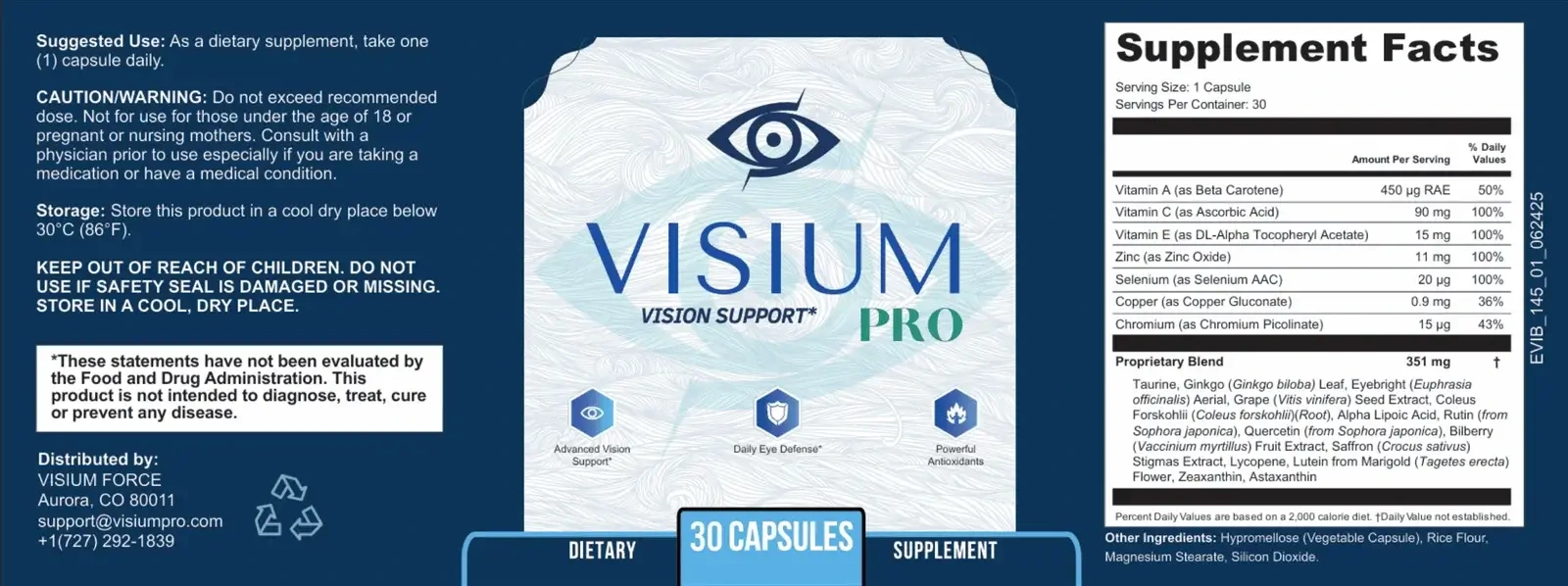
Supplied label artwork. Open the image to inspect the full text. Compare it with the current bottle before use.
The disclosed amounts
| Nutrient | Amount | Label detail |
|---|---|---|
| Vitamin A | 450 mcg RAE | As beta carotene |
| Vitamin C | 90 mg | As ascorbic acid |
| Vitamin E | 15 mg | As DL-alpha tocopheryl acetate |
| Zinc | 11 mg | As zinc oxide |
| Selenium | 20 mcg | As selenium AAC on the supplied label |
| Copper | 0.9 mg | As copper gluconate |
| Chromium | 15 mcg | As chromium picolinate |
| Proprietary blend | 351 mg | Combined blend; individual amounts are not disclosed |
Transcribed from the supplied image. Daily Value percentages are not reproduced: some percentages printed on the artwork appear inconsistent with the listed amounts. Confirm the current label with the seller. Label source
What is in the 351 mg blend?
The label names these ingredients, in the following order:
The 351 mg is the total for the entire blend, not 351 mg of each ingredient. No individual amount is shown for lutein, zeaxanthin, saffron, ginkgo or the other blend components. Label source
Put the best-known ingredients in context
Lutein and zeaxanthin
These appear in the formula, but their separate doses are not disclosed. AREDS2 used specific nutrient amounts in a specific eye-disease population; its findings are not proof of this blend’s effectiveness. NEI: AREDS2
Bilberry and ginkgo
Both are present on the label. NCCIH describes limitations in the human evidence for these botanicals; ginkgo also raises medication-interaction concerns. Including them is not the same as demonstrating better vision. NCCIH: bilberry NCCIH: ginkgo
The other blend ingredients
This review does not assign clinical benefits or study-equivalent doses to the remaining botanicals and antioxidants. Their presence is documented by the label, but an undisclosed dose makes a meaningful product-to-study comparison difficult.
| Ingredient / research context | Study amount or finding | Match to this product? |
|---|---|---|
| Lutein + zeaxanthin in AREDS2 | NEI describes 10 mg lutein and 2 mg zeaxanthin in the AREDS2 formula. The research concerns progression of AMD in particular patient groups—not improved eyesight for every healthy adult. | Unknown. Neither individual amount is disclosed in the supplied Visium Pro blend. |
| Vitamins and minerals in the AREDS2 formulation | NEI lists vitamin C 500 mg, vitamin E 400 IU, zinc 80 mg and copper 2 mg. Those are formulation details, not advice to increase this product's dose. | Different stated amounts. See the complete label comparison; do not substitute one formula for another without clinical advice. |
| Bilberry and night-vision claims | NCCIH reports that better-quality studies have not shown improved night vision in healthy people. | Not established. The blend does not disclose an individual bilberry amount or extract standardisation. |
NEI research context · NCCIH evidence summary · Supplied label
Can the supplied formula be matched to verified studies?
| Ingredient / verified study | What was actually studied | Can the supplied Visium Pro label establish a match? |
|---|---|---|
| Lutein + zeaxanthin PMID 23644932 | 10 mg + 2 mg in a defined AMD trial, not a general vision-enhancement experiment. | No. The individual amounts are undisclosed; the broader formulation also differs. |
| Bilberry: screen-task outcome PMID 32106548 | 240 mg of a standardized extract for 12 weeks; an objective accommodation measure was studied. | No. The extract specification and individual amount are not disclosed. |
| Bilberry: night vision PMID 10767671 | A different extract regimen did not improve night visual acuity or contrast sensitivity in 15 healthy men. | An ingredient name is not proof that a night-vision claim is supported. |
| Ginkgo: conflicting trials PMID 12578781 PMID 24282229 | Both used 40 mg extract three times daily in normal-tension glaucoma; their findings differed. | No. The supplied label lists ginkgo leaf within the blend, not a separately quantified matching extract. |
These study quantities are context, not recommended doses. Do not increase the number of Visium Pro capsules to match one ingredient study; that also increases every other ingredient. The full study summaries identify the relevant populations and results.
Directions, capsule materials and warnings
The artwork says to take one capsule daily. Other ingredients are hypromellose (vegetable capsule), rice flour, magnesium stearate and silicon dioxide. A vegetable capsule alone does not independently certify every ingredient as vegan or allergen-free. Label source
The label says not to exceed the recommended dose and not to use the product under age 18, during pregnancy or while nursing. It advises medical consultation when taking medication or living with a medical condition. Follow the current bottle and professional advice rather than an online article. Label source
Three questions worth asking the seller
- Can you provide the most recent Supplement Facts label and the amounts of lutein and zeaxanthin?
- Is a batch-specific independent certificate of analysis available for identity, potency and contaminants?
- Do the current allergen, capsule and storage statements match the bottle that will be delivered?
A clear written response is more useful than a general “natural formula” badge.
How should you read the label without inventing missing quantities?
A proprietary-blend total states the combined quantity, not the amount of every named ingredient. The supplied artwork lists 351 mg across 14 blend ingredients. Dividing that total by 14 would produce only a mathematical average under an unsupported equal-allocation assumption; it would not establish any ingredient’s actual dose.
The quantity of an ingredient and its form are separate questions. A botanical leaf, a fruit extract and a standardized extract used in a trial should not be treated as identical merely because the plant name matches. Ask what the current product uses, which extract specification applies and whether that information describes the finished product being shipped.
A declared vitamin amount also has a unit and form. Keep the listed RAE, mg or mcg with the numeral when transcribing it. This guide does not silently correct the supplied artwork’s Daily Value percentages or turn those percentages into an unsupported dose claim.
| Question | Supported answer |
|---|---|
| How many capsules are shown? | 30 capsules, with one capsule per serving on the supplied artwork; current seller directions still require confirmation. |
| Are lutein and zeaxanthin present on the label? | Yes; their separate amounts are not provided. |
| Does the label establish study-equivalent botanical doses? | No; quantities and specifications needed for that match are missing. |
| Does a vegetable capsule prove a fully vegan finished product? | No; capsule material alone does not verify every component or manufacturing input. |
| Does the label prove batch purity or potency? | No; that requires different evidence, such as a relevant authentic testing report. |
This is why the comparison page reports “not disclosed” instead of zero or an estimated amount. Missing information is not evidence that the ingredient is absent, but it prevents a reliable dose-to-dose comparison. Compare what is known and request the rest.
Check the sources
References & review materials
Linked research is context, not an endorsement of this product. Seller statements are not independent clinical evidence.
- Supplied Visium Pro Supplement Facts image ↗
Product label supplied for this review; verify against the bottle you receive.
- National Eye Institute: AREDS / AREDS2 questions ↗
Study populations, formula amounts and limits of the AREDS evidence.
- NCCIH: Bilberry ↗
Human evidence, night-vision claims and safety limitations.
- NCCIH: Ginkgo ↗
Evidence limitations, side effects and medication interactions.
- PMID 23644932 — AREDS2 randomized trial (2013)
Exact study quantities do not establish the quantities in the supplied Visium Pro blend.
- PubMed PMID 10767671 — Muth ER, Laurent JM, Jasper P. The effect of bilberry nutritional supplementation on night visual acuity and contrast sensitivity. Alternative Medicine Review, 2000.
Primary ingredient research, not a trial of the marketed Visium Pro formula. No improvement in night visual acuity or contrast sensitivity in the studied 15 men.
- PubMed PMID 32106548 — Kosehira M, Machida N, Kitaichi N. A 12-Week-Long Intake of Bilberry Extract (Vaccinium myrtillus L.) Improved Objective Findings of Ciliary Muscle Contraction of the Eye: A Randomized, Double-Blind, Placebo-Controlled, Parallel-Group Comparison Trial. Nutrients, 2020. DOI: 10.3390/nu12030600. Open full text in PMC.
Primary ingredient research, not a trial of the marketed Visium Pro formula. Specific screen-task accommodation measurements improved at specified visits; not a Visium Pro trial.
- PMID 12578781 — Ginkgo and normal-tension glaucoma trial (2003)
Exact study quantities do not establish the quantities in the supplied Visium Pro blend.
- PubMed PMID 24282229 — Guo X and colleagues. Effect of Ginkgo biloba on visual field and contrast sensitivity in Chinese patients with normal tension glaucoma: a randomized, crossover clinical trial. Investigative Ophthalmology & Visual Science, 2014. DOI: 10.1167/iovs.13-13168.
Primary ingredient research, not a trial of the marketed Visium Pro formula. No significant treatment differences in visual-field or contrast-sensitivity changes; 35 randomized and 28 completed.
Related guides: lutein and zeaxanthin · testing documents · label checklist.
Published: